News briefs:August 14, 2006

The time is 19:00 (UTC) on August 14th, 2006, and this is Audio Wikinews News Briefs.

Contents

  • 1 Headlines
    • 1.1 UN sponsored ceasefire in Israel-Lebanon begins
    • 1.2 Tamil Tigers say Sri Lanka’s government bombed orphanage
    • 1.3 Colombo land mine explosion kills seven
    • 1.4 Suspected low pathogenic H5N1 Bird Flu virus found in the United States
    • 1.5 Ariel Sharon’s condition worsens
    • 1.6 Fresh pictures of Castro and Chavez shown in Cuban media
    • 1.7 AIDS conference opens without PM
    • 1.8 Edinburgh Extends Parking Zone
    • 1.9 Wellington, New Zealand university student missing
    • 1.10 Court date “as needed” for lawsuit against Buffalo, N.Y. hotel proposal
  • 2 Closing statements

[edit]

Posted in Uncategorized

Colleges offering admission to displaced New Orleans graduate students

See the discussion page for instructions on adding schools to this list.Tuesday, September 13, 2005

NAICU has created a list of colleges and universities accepting and/or offering assistance to displace faculty members. [1]Wednesday, September 7, 2005

This list is taken from Colleges offering admission to displaced New Orleans students, and is intended to make searching easier for faculty, graduate, and professional students.

In addition to the list below, the Association of American Law Schools has compiled a list of law schools offering assistance to displaced students. [2] As conditions vary by college, interested parties should contact the Office of Admissions at the school in question for specific requirements and up-to-date details.

The Association of American Medical Colleges is coordinating alternatives for medical students and residents displaced by Hurricane Katrina. [3]

ResCross.net is acting as a central interactive hub for establishing research support in times of emergency. With so many scientists affected by Hurricane Katrina, ResCross is currently focused on providing information to identify sources of emergency support as quickly as possible. [4]

With so many scientists affected by Hurricane Katrina, ResCross is currently focused on providing information to identify sources of emergency support as quickly as possible.

Physics undergraduates, grad students, faculty and high school teachers can be matched up with housing and jobs at universities, schools and industry. [5] From the American Association of Physics Teachers, the Society of Physics Students, the American Institute of Physics and the American Physical Society.

If you are seeking or providing assistance, please use this site to find information on research support, available lab space/supplies, resources, guidelines and most importantly to communicate with fellow researchers.

The following is a partial list, sorted by location.

Alabama |Alaska |Arizona |Arkansas |California |Colorado |Connecticut |Delaware |District of Columbia |Florida |Georgia |Hawaii |Idaho |Illinois |Indiana |Iowa |Kansas |Kentucky |Louisiana |Maine |Maryland |Massachusetts |Michigan |Minnesota |Mississippi |Missouri |Montana |Nebraska |Nevada |New Hampshire |New Jersey |New Mexico |New York |North Carolina |North Dakota |Ohio |Oklahoma |Oregon |Pennsylvania |Rhode Island |South Carolina |South Dakota |Tennessee |Texas |Utah |Vermont |Virginia |Washington |West Virginia |Wisconsin |Wyoming |Canada

Posted in Uncategorized

IMF: World on brink of recession; prepares special loan program

Thursday, October 9, 2008

The head of the International Monetary Fund (IMF) says the world is on the brink of a global recession but predicts the economy will begin to recover by late 2009.

Dominique Strauss-Kahn, Managing Director of the IMF, stressed nations must work together to avert a global recession and warns there is “no domestic solution” to the crisis. He also said this week’s coordinated interest rate cuts around the world are a good example of the international cooperation needed to restore faltering economies.

Furthermore, he announced the IMF has activated an emergency program Wednesday that allows the fund to provide loans more easily and quickly to emerging countries in economic trouble. This program was first used during the 1997 Asian crisis.

The program might be used in Iceland, which has seen major problems hitting the financial sector. Iceland has been forced to nationalize the three largest banks and, most recently, Kaupthing Bank.

The IMF chief made these remarks in Washington D.C. on Thursday, as top officials from IMF nations and the G-7 industrialized countries are gathering for meetings on economic issues. U.S. President George Bush is set to meet with G-7 finance ministers at the White House on Saturday.

Posted in Uncategorized

The Deadliest Fall

18 December 2004

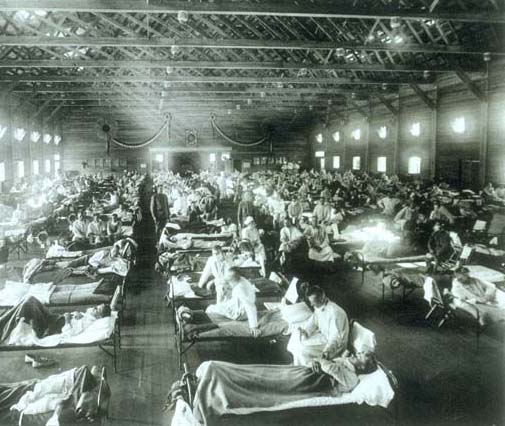
Emergency hospital during 1918 influenza epidemic, Camp Funston, Kansas (source: National Museum of Health and Medicine, AFIP).

A bout of the flu can be mild. In young, healthy adults, many infections pass unnoticed. But sometimes the influenza virus evolves into a strain that decimates its victims. The worst known strain swept the world in the Fall of 1918, infecting 500-1000 million and killing 40-100 million, about 2-5% of people.

There are several theories about where the pandemic began, but the likeliest origin was in Haskell County, Kansas, in the United States. People in the sparsely populated county, where farmers raised pigs, poultry, cattle, and grain, began suffering from influenza in late January 1918. Unusually for flu, it was young, healthy adults who were hardest hit. Victims fell ill suddenly, many progressing to pneumonia and dying, often within days. Within weeks, however, the epidemic ended. The natural geographic isolation of this community normally might have contained the fatal flu in a sort of unintentional quarantine, but the First World War intervened. Men were uprooted from their home towns and congregated in huge numbers in army camps for training and then shipping out to other camps or to fight in Europe. The destination for men from Haskell County was Camp Funston, part of Fort Riley, Kansas, where the first influenza case was reported in early March. As soldiers moved among camps, the virus spread. Within two months, the epidemic spread to most of the army camps and most of the largest cities in the United States. As American soldiers went to France, so did the virus, spreading first from the port of Brest.

The flu then spread worldwide. The pandemic reached its height in the Fall of 1918. Spain was affected early, and because Spain was not fighting in the World War, there was no wartime censorship, and news of the outbreak became widely known, leading to the flu being called the Spanish Flu in many countries. In Spain, however, it was called French Flu or the Naples Soldier. In India, about 12 million people died of flu. In some US cities, people died so quickly that morticians couldn’t cope with the bodies. According to Jessie Lee Brown Foveaux, who worked in the Fort Riley laundry during the epidemic: “They were piling them up in a warehouse until they could get coffins for them.”

The disease started with cough, then headache. Temperature, breathing and heart rate increased rapidly. In the worst cases, pneumonia came next, the lungs filling with liquid, drowning the patients and turning them blue from lack of air. Patients bled from every orifice: mouths, noses, ears, eyes. Those who survived often suffered temporary or permanent brain damage. Several million developed encephalitis lethargica, in which victims were trapped in a permanent sleeplike and rigid state, as portrayed in the 1990 movie “Awakenings.” In others, normal thought processes were impaired. During negotiations to end World War I, US President Woodrow Wilson was struck with flu, and people around him noted that his mental abilities never fully recovered. The French leader George Clemenceau had wanted harsher punishment of Germany than Wilson had desired. Clemenceau may have convinced Wilson in his weakened state to accept such harsh terms, which may have been one of the factors causing World War II.

Since flu is highly contagious early in the illness, even before symptoms appear, strict quarantine may be necessary to stop its spread during an epidemic. Australia kept its 1918 flu death rate relatively low by enforcing quarantines. However, in many parts of the world, public health officials hesitated to impose such measures, giving the disease time to gain a foothold. In the US city of Philadelphia, a rally of half a million people was planned in September 1918 to sell bonds to fund the war, at just the time when the flu started to infect residents. Although doctors warned the public health director to cancel the rally, he wanted to meet the city’s quota to raise money for the war and refused to cancel the event. Within days after the rally, half a million city residents caught the flu.

Why was the 1918 flu so deadly? The influenza virus wasn’t preserved at the time of the outbreak, at least on purpose. But in the late 1990s researchers Ann Reid, Jeffery K. Taubenberger, and their colleagues extracted and sequenced the genetic material of the virus, RNA, from tissue of victims who died in the pandemic. They used bits of lung that were preserved in formalin from victims on army bases or from victims buried in permafrost in the Alaskan village of Brevig Mission, where flu killed 85% of adults. Comparisons with known flu viruses in humans, pigs, and birds suggest that some genes of the 1918 virus came from birds or an unknown animal source. Other scientists then were able to show that the amino acid sequence of hemagglutinin protein from the 1918 virus had several changes from other flu viruses that may have helped it to easily bind and invade human cells, and that made the virus look different enough from earlier flu virus strains that people had no immunity.

The possibility exists that another flu pandemic will sweep the world like the one in 1918. In 2004, an H5N1 influenza virus has killed millions of birds and at least 30 people in southeast Asia. So far this virus strain has not evolved the ability to pass directly from human to human, but that possibility becomes more likely as the bird flu pandemic continues and humans remain in contact with chickens, ducks, and other birds. The virus has killed two-thirds of people reported to be infected. Dr. Tim Uyeki, an epidemiologist for the US Centers for Disease Control, says, “you have the ingredients in Asia right now for a public health disaster.”

But since sequences of this bird flu virus are known, it may be possible to develop a vaccine or set of vaccines to protect against it. At a special meeting of influenza experts on November 11th and 12th, World Health Organization influenza program chief Klaus Stohr said, “It is not only possible, but also important, that influenza pandemic vaccines be made available… and there’s a shared responsibility needed to make that happen…. We have a huge window of opportunity now.”

Posted in Uncategorized

The Dream Wedding With The Perfect Bouquet In Ankeny

byAlma Abell

One of the things a bride and groom may think of when planning a wedding is choosing the flowers, especially choosing the bridal bouquet. For many, a wedding is not a wedding without the flowers. Every bride wants the flowers and the bridal bouquet to reflect the her own taste and personality. The flowers can create the theme of the wedding and tie all the colors used in the dresses and decorations together. There are no right or wrong choices in picking the flowers, but it can be difficult to narrow down a choice and still stay on budget.

[youtube]http://www.youtube.com/watch?v=w_dLpTwERfk[/youtube]

There are some simple things to remember when picking the flowers such as less can be more. Flowers should be the splash of color and the embellishment that pulls everything together but does not overwhelm. Using inexpensive foliage or Baby’s Breath splashes, placed in just the correct spots can stretch the budget while giving the appearance of having more than there actually is. Remember that center pieces do not need to dominate the tables. Large centerpieces can eat up a lot of the budget. A small centerpiece does not mean unnoticeable if it is done right and tasteful. Save a good piece of the floral budget for the bridal bouquet since it is the prettiest and most important of the flowers. Finding someone who can provide that all important Bouquet in Ankeny also means finding the right florist who understands how to use the floral budget wisely.

Keeping at or under the floral budget is paramount when planning a wedding, but the bride’s ideas and sense of style need to be addressed. A bride should expect a florist to work within the budget, understand the theme and assist in making the wedding day something a bride dreams of. One such shop that can provide the bride’s ideal bridal flowers and a spectacular Bouquet in Ankeny is Boesen The Florist shops. Creating a beautiful wedding can be stressful, but working out the style, colors and budget of the flowers, with a competent, caring and talented florist can create an exquisitely beautiful wedding.

Explosion in Pakistan mosque kills dozens

Friday, June 5, 2009

A bomb blast at a mosque in northwestern Pakistan is suspected to have killed at least forty people on Friday.

According to police reports, the explosion happened in a village located in the Upper Dir district of the North-West Frontier Province. The incident occurred while worshipers were offering the Friday prayers.

“Around 40 people are killed. We have no idea as yet how many have been wounded,” said Atif-ur-Rehman, a senior government administrator of Upper Dir.

The mosque was damaged heavily by the explosion, and many people have been trapped under debris.

“A large number of body parts are scattered in the mosque. We don’t know whether these are parts of the dead who have been identified or of others,” said Umer Rehman, one of the village’s residents, to the Reuters news agency.

This is the ninth bomb blast in Pakistan since the country’s armed forces started attacks against the [[|Pakistani Talian|Taliban]] in the nearby Swat valley from the past few months, in an attempt to force the fighters out of the area.

President Zardari and Prime Minister Gillani both condemned the attack. The London-based Muttahida Qaumi Movement chief, Altaf Hussain, has also condemned the blast.

Posted in Uncategorized

South Korea: Fire in hospital housing elderly people kills at least 37

Friday, January 26, 2018

Fire broke out on Friday morning and destroyed the bottom two floors of a six-story hospital in Miryang, South Korea, killing at least 37 people, most of them elderly. More than a hundred injuries were reported, with eighteen people in critical condition. This is the highest death toll from fire in South Korea in almost a decade.

The fire is believed to have started at about 7:30 local time, according to fire chief Choi Man-woo. It originated on the ground floor in the emergency room as per various officials. The hospital has 98 beds and a medical staff of about 35, and specializes in long-term care of elderly patients. It adjoins a nursing home, all of whose 94 residents were evacuated. Staff carried some patients out of the hospital on their backs.

One patient, Jang Yeong-jae, who told his story to JoongAng Ilbo, said he escaped by removing a screen from a window to get to a ladder placed by firefighters. He described people “running around in panic, falling over and screaming as smoke filled the rooms”. The majority of the victims died from smoke inhalation and are believed to be elderly, said the head of the city’s public hospital, Chun Jae-kyung. A doctor, a nurse, and a nursing assistant have died, according to the fire service; it took three hours to put out the fire.

In a press briefing, Seok Gyeong-sik, the director of the hospital, apologized to patients and their families. Son Kyung-chul, its chairman, stated that there were no sprinklers because the facility was small. Sprinklers are being installed in the nursing home, where a new law requires them by June 30.

Last month, 29 people died in a fire in a gym in Jecheon; the owner and the manager were arrested for safety violations. In 2014, a blaze in a nursing home in Jangseong left 21 dead. The President of South Korea, Moon Jae-in, responded to the Friday fire by calling an emergency meeting of his staff, and promised that the cause would be found rapidly “to prevent the recurrence of the fire in the future”.

Posted in Uncategorized

Eleventh Docudays UA concludes

Monday, March 31, 2014

The Eleventh International Human Rights Documentary Film Festival Docudays UA, in Kyiv, Ukraine, ended on Friday.

The Awards Ceremony was held in the Red Hall of the Kyiv Cinema House. There were 36 documentary films competing for prizes in three festival programs: DOCU/Short, DOCU/Right, DOCU/Life. There were also special prizes from Students’ Jury, Audience Award, and the Andriy Matrosov Award from Docudays UA Organizing Committee.

The special guest of the Awards Ceremony was a symbol of the festival — Nikita Mikhalko. He is featured on the official posters of the festival. Nikita was on Maidan Nezalezhnosti on February 19, in the morning. The picture of him was chosen by the organizers as the “image that would deliver the spirit of our [Docudays UA] festival to the best of its possible might”. The piece of movie where he is taking tangerines from a woman that morning has become the official trailer of the festival. The episode is featured in the opening film of the festival Euromaidan: Rough Cut. Thus Nikita and his burning glasses have become the symbols of the festival. The organizers decided to find out who the symbol of the festival was, and if he was alive. They have started looking for him and luckily, they were able to ask him to come as a special guest of the Awards Ceremony. Nikita had the opportunity to say on the microphone, “Slava Ukraini” (Glory to Ukraine), and have the whole hall hollering back at him, “Heroiam Slava” (Glory to the Heroes).

The Eleventh Docudays UA Winners are (in the order of awarding):

Audience Award

The Audience Award went to Joanna, directed by Aneta Kopacz, Poland, 2013.

Student’s Jury Award

The Students’ Jury Award went to Tucker and the Fox, directed by Arash Lahooti, Iran, 2013, awarded for “an optimistic story about a life-long passion”.

DOCU/Short

Joanna, directed by Aneta Kopacz, Poland, 2013, received special mention. The jury chose it for “filmmaker’s ability to be both intimate and discreet”

Mom, directed by Lidia Sheinina, Russia, 2013, received special mention for “ability of the filmmaker to find in the closed world of one apartment ‘things that quicken the heart'”.

The main prize went to Liza, Go Home!, directed by Oksana Buraja, Lithuania, Estonia, 2012. The film was awarded for “filmmaker’s poetic sensibility and respect for other humans’ secrets”.

Andrei Zagdansky, a Ukrainian-American, was awarding. The other two members of the jury were Victoria Belopolskaya of Russia, and Stéphanie Lamorré of France.

DOCU/Right

No Fire Zone: The Killing Fields of Sri Lanka, directed by Callum Macrae, UK, 2013, received special mention. The film was awarded for “the powerful use of video advocacy in global awareness-raising and opinion-shaping regarding the mass murders of civilians belonging to a Tamil minority in Sri Lanka”.

Captain and His Pirate, directed by Andy Wolff, Belgium, Germany, 2012, received special mention for “exceptional courage of the film crew and an outstanding presentation of international piracy phenomenon as presented by a victim and his prison guard”.

The main prize went to Mother’s Dream, directed by Valerie Gudenus, Switzerland, 2013. The jury awarded the film for “a highly sensitive, empathic, and artistic presentation of a controversial and socially resonant human rights problem, affecting the fates of women and children globally”.

Natalka Zubar of Ukraine announced the winners. The other two members of the jury were Andrzej Poczobut of Belarus, and Oksana Sarkisova of Hungary.

DOCU/Life

Crepuscule, directed by Valentyn Vasyanovych, Ukraine, 2014, received special mention. The film was awarded for “a visually and emotionally superior depiction of human resilience, sensibility, and interdependence”.

Night Labor, directed by David Redmon and Ashley Sabin, USA, Canada, 2013, received special mention for “a provocative, atypical, allegorical description of industrial work and personal freedom”.

The main prize went to The Last Limousine, directed by Daria Khlestkina, Russia, 2014, awarded for “a dignified, compassionate portrayal of state-factory workers lost in transition, but not in humanity”. The jury mentioned the film was perfectly casted.

The whole jury was present: Boris Miti? of Serbia, Chris McDonald of Canada, and Simone Baumann of Germany.

Andriy Matrosov Award from the Docudays UA Organizing Committee

The Andrey Matrosove Award went to A Diary of a Journey, directed by Piotr Stasik, Poland, 2013.

  • 1
  • 2
  • 3
  • 4
  • 5
  • 6
  • 7
  • 8
  • 9
  • 10
  • 11
  • 12
  • 13
  • 14
  • 15
  • 16
  • 17
  • 18
  • 19
  • 20
  • 21
  • 22
  • 23
  • 24
  • 25
  • 26
  • 27
  • 28
  • 29
  • 30
  • 31
  • 32
  • 33
  • 34
  • 35

People are gathering. Image: Antanana.

A queue is forming. Image: Antanana.

The Red Hall of the Kyiv Cinema House. Image: Antanana.
The hosts of the event are the journalists Andrii Saichuk and Nataliia Humeniuk. Image: Antanana.
Nataliia Humeniuk, translator and photographer. Image: Antanana.
Nikita Mikhalko is featured on the festival poster and trailer. Image: Antanana.
The festival gift shop team is giving the Audience Award. Image: Antanana.
The film Joanna (director Aneta Kopacz, Poland, 2013) is awarded. Image: Antanana.
The representative of Aneta Kopacz is taking the prize. Image: Antanana.
The Students’ Jury: Viktor Kylymar, Oleksandr Shkrabak, Halia Vasylenko, Petro Vyalkov, Tetyana Chesalova. Image: Antanana.
Tucker and the Fox (director Arash Lahooti, Iran, 2013) is awarded. Image: Antanana.
The googles would help him to film even more. Image: Antanana.
The Festival diploma. Image: Antanana.
The cobblestone from Maidan Nezalezhnosti is the main festival trophy. Image: Antanana.
The trophy goes to Iran. Image: Antanana.
Andrei Zagdansky (Ukraine) announces the winners for DOCU/Short. Image: Antanana.
The first special mention: Joanna (Aneta Kopacz, Poland, 2013). Image: Antanana.
The representative of the director. Image: Antanana.
The 2nd special mention: Mom (director Lidia Sheinina, Russia, 2013). Image: Antanana.
Main prize: Liza, Go Home! (director Oksana Buraja, Lithuania, Estonia, 2012). Image: Antanana.
The journalist, director Natalka Zubar. Image: Antanana.
Special mention: No Fire Zone: The Killing Fields of Sri Lanka (director Callum Macrae, UK, 2013) Anthem of Ukraine. Image: Antanana.
Special mention: Captain and His Pirate (director Andy Wolff, Belgium, Germany, 2012). Image: Antanana.
Main prize: Mother’s Dream (director Valerie Gudenus, Switzerland, 2013). Image: Antanana.
Ambassador of Switzerland to Ukraine Christian Schoenenberger is taking the prize. Image: Antanana.
Chris McDonald (Canada), Simone Baumann (Germany). Image: Antanana.
Special mention: Crepuscule (director Valentyn Vasyanovych, Ukraine, 2014). Image: Antanana.
Boris Miti? (Serbia), Simone Baumann. Image: Antanana.
Special mention: Night Labor (directors David Redmon and Ashley Sabin, USA, Canada, 2013). Image: Antanana.
Main prize: The Last Limousine (director Daria Khlestkina, Russia, 2014). Image: Antanana.
The Last Limousine. Image: Antanana.
Daria Khlestkina. Image: Antanana.
The cobblestone from Maidan Nezalezhnosti is taken to Moscow. Image: Antanana.
Andriy Matrosov Award from the Organizing Committee. Image: Antanana.
A Diary of a Journey (director Piotr Stasik, Poland, 2013) is awarded. Image: Antanana.

After the ceremony The Last Limousine, the winning film of DOCU/Life program, was screened.

The festival was first held in 2003, called at that time Docudays on Human Rights. In 2006 the festival was accepted as part of the international Human Rights Film Network at the International Documentary Film Festival Amsterdam. It is usually held during the last week of March.

Posted in Uncategorized

Wal-Mart cuts ties with PR consultant over controversial Republican TV ad

Monday, October 30, 2006

Wal-Mart severed links with Terry Nelson, a Republican strategist, last night because he had connections to a controversial Republican Party advertisement in Tennessee. The ad’s purpose was to blast Democratic Senate candidate Harold Ford Jr, who is running against Republican Bob Corker.

A blonde woman in the ad says, “I met Harold at the Playboy party”. As the spot ends, she winks and says breathily: “Harold, call me!”. The ad also “criticised” Canada. “Canada can take care of North Korea,” a man in the television ad says. “They’re not busy.”

Nelson and his company, CrossLink Strategy Group, were hired by Wal-Mart last year in an attempt to help the company.

Jesse Jackson, an American politician, and other leaders signed a letter distributed by WakeUpWal-Mart.com, asking the company to end its relationship with Nelson.

In an interview with the Associated Press Nelson said, “There was no intention to offend anybody and it’s unfortunate if people took offense. That was certainly not what people planned for or hoped for.”

A spokesman for Wal-Mart, David Tovar, issued a statement saying Nelson’s company had “sent a letter to Wal-Mart ending its working relationship with our company.”

Posted in Uncategorized